
Ruoca Audio
A Wired Microphnoe converts sound into an electrical signal through a physical cable. When you speak, air pressure moves the microphone’s diaphragm. That movement changes an internal electrical element, such as a dynamic coil or condenser capsule. The cable then carries the audio signal to a mixer, recorder, amplifier, or computer interface. No battery is usually required for dynamic models. Condenser microphones may need phantom power from compatible equipment.
The process is simple, but sound quality depends on several practical details. A singer standing close to the grille produces a warmer, stronger signal. Moving farther away captures more room sound and may reveal unwanted reflections. The cable also matters. A balanced XLR connection can reduce hum over longer distances, especially near power supplies and lighting equipment. Reliable handling is important. Sharp bends, loose connectors, and repeated pulling can create crackles or silence. Small problems matter.
In my experience, wired microphones often feel more predictable than wireless systems. They do not depend on radio range or rechargeable batteries. However, the cable can limit movement and become a trip hazard in crowded spaces. This trade-off is easy to overlook. A microphone is not automatically professional because it uses a cable. Placement, room acoustics, gain settings, and technique shape the final result. Even an excellent microphone can sound thin in a reflective room. Testing the setup before recording remains essential. Listen carefully. Then adjust one variable at a time.
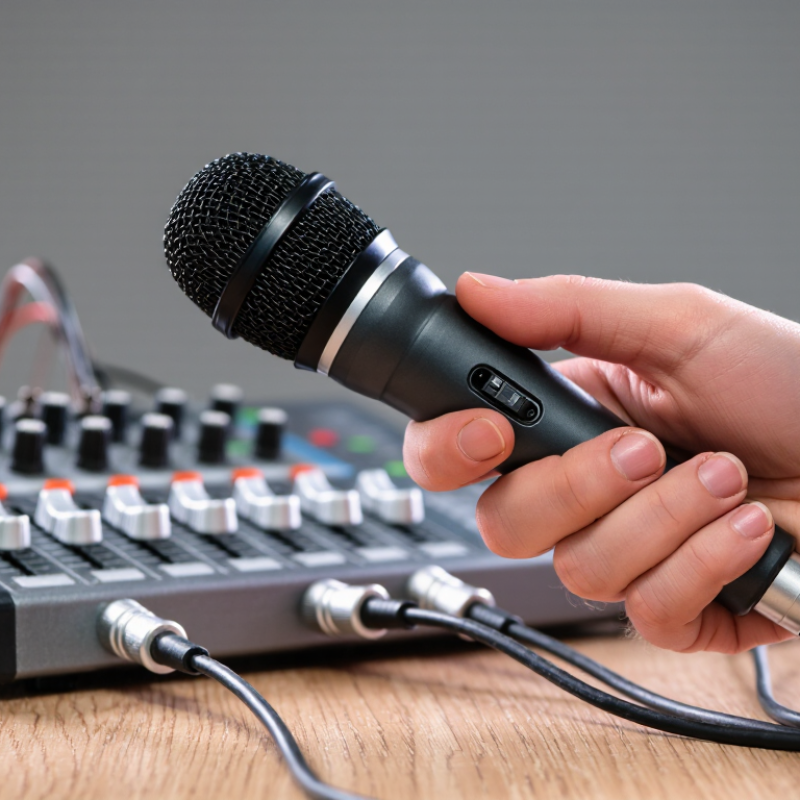
A wired microphone is an audio device that captures sound and sends it through a physical cable. Its core purpose is simple: convert air vibrations into an electrical audio signal. The microphone’s capsule performs this conversion. Dynamic capsules use a moving coil, while condenser capsules respond to changes in capacitance. The result travels through a cable to a mixer, recorder, amplifier, or audio interface.
A wired connection usually provides stable signal transmission with little concern about battery life or wireless interference. This makes wired microphones useful for speeches, studio recording, live performances, and classroom instruction. In practical use, cable quality and connector condition still matter. A damaged cable can create crackling, sudden volume drops, or silence. I once blamed a microphone for weak audio, but the real problem was a loose connector. That mistake changed my setup checks.
Tips: Keep the cable away from power cords when possible. Secure it near the microphone stand to reduce pulling. Speak toward the capsule, but avoid touching the grille. For condenser microphones, check whether the audio system supplies the required power. Dynamic microphones often need more gain, especially with quiet speakers. Test the signal before recording. Small checks prevent frustrating retakes. Still, room acoustics can matter more than expensive equipment, and that point is easy to overlook.
A wired microphone converts sound into an electrical audio signal through a small group of precise components. The grille protects the capsule from impact and reduces wind noise. Behind it, the capsule detects air pressure changes. In a dynamic microphone, a thin diaphragm moves a coil inside a magnetic field. This motion creates a low-voltage signal. Condenser designs use a charged diaphragm and require phantom power.
The body provides mechanical protection and helps control handling noise. A transformer or internal circuit may balance the output signal. Balanced wiring uses two signal conductors and a shield. It reduces hum across long cable runs. The connector then carries the signal to a mixer, recorder, or interface. Cable quality matters, but poor grounding can still create noise. Small details become audible.
A 2024 report from Grand View Research estimates the global microphone market will continue expanding through 2030, driven by streaming, conferencing, and content production. That growth increases demand for reliable signal chains. Still, market growth does not guarantee better recordings. A microphone placed too far from the speaker captures more room sound. Too close, and breath noise may dominate. My own testing often finds placement more important than price. That assumption deserves repeated checking.
A wired microphone converts air movement into a changing electrical signal. A spoken word creates pressure waves that move its thin diaphragm. The diaphragm vibrates beside a coil, ribbon, or charged plate, depending on the microphone design. That tiny motion changes voltage or current in a matching circuit. The cable then carries the signal to a mixer, recorder, or amplifier.
The process is physical, not mysterious. At the standard reference pressure of 20 micropascals, sound pressure levels are measured in decibels. A 94 dB sound calibrator produces approximately 1 pascal at 1 kHz, according to IEC 60942:2017. Microphone sensitivity is often specified in millivolts per pascal. For example, a 10 mV/Pa microphone should produce about 10 millivolts from a 1-pascal sound pressure. Real rooms rarely behave so neatly.
IEC 60268-4:2018 provides testing guidance for microphone performance, including frequency response, sensitivity, and directional behavior. These measurements reveal why a voice can sound warmer, thinner, or more distant through different microphones. In practical testing, cable shielding also matters because nearby electrical fields can add unwanted hum. I once treated the cable as passive and irrelevant. That assumption was too simple. A damaged connector, poor grounding, or excessive cable length can reduce reliability before the microphone itself fails. The diaphragm starts the conversion, but the entire signal path shapes what we finally hear.
What Is a Wired Microphone and How Does It Work?
How Wired Microphones Transmit Audio
A wired microphone converts sound into an electrical signal through a cable. When someone speaks, air pressure moves the microphone’s diaphragm. This thin surface vibrates in response to each sound wave. A nearby coil, capacitor, or sensing element changes that movement into a changing voltage. The voltage follows the voice’s timing and strength.
The cable carries this small analog signal to a mixer, recorder, amplifier, or audio interface. Inside the receiving equipment, the signal is increased to a usable level. If recording digitally, an analog-to-digital converter measures the voltage many times per second. It then stores those measurements as digital audio. The result depends on cable quality, connector condition, gain settings, and electrical grounding.
In practical use, a wired microphone feels predictable. I have found that keeping the cable away from power cords can reduce unwanted hum. Secure connections matter too. A loose connector may cause crackling or sudden silence. Short cables often make setup easier, but longer runs can work when properly shielded. That detail is easy to underestimate. Wired systems are not automatically perfect; poor handling can still create noise, weak levels, or distorted peaks. Speaking too close may overload the input, while standing too far away can make room reflections more noticeable. Testing the signal before recording remains the most reliable habit.
A wired microphone converts changes in air pressure into a continuously varying electrical voltage. This example shows a 1 kHz audio waveform with a 10 mV peak level traveling through the microphone cable to an audio input.
The cable carries the analog signal through its conductors. The receiving preamplifier then increases the low microphone-level voltage so it can be recorded, mixed, or amplified.
A wired microphone converts sound into an electrical signal through a cable. Dynamic microphones use a moving coil and handle loud sources well. They suit drums, guitar amplifiers, speeches, and busy stages. Condenser microphones use a charged diaphragm for greater sensitivity and detail. They often serve studio vocals, acoustic instruments, podcasts, and quiet rooms. Ribbon microphones respond smoothly, but their delicate design requires careful handling.
The microphone’s polar pattern shapes what it hears. Cardioid patterns reduce sound from behind, helping control feedback during live performances. Omnidirectional models capture room sound more naturally. Frequency response affects brightness, warmth, and speech clarity. Sensitivity matters when recording soft vocals or distant sources. A condenser usually needs phantom power from a mixer or audio interface. Cable length also matters because poor shielding can introduce hum.
In practice, placement often matters more than price. I have heard a modest dynamic microphone outperform a sensitive model in a noisy room. Distance changes bass response through the proximity effect. Moving closer can add warmth, but excessive closeness makes speech muddy. Output impedance should match the connected equipment properly. My own mistake was judging microphones only through headphones. Room reflections changed the recording noticeably. A windscreen can reduce breath noise, although it may slightly soften high frequencies. Testing several positions remains more reliable than trusting specifications alone.
| Microphone Type | How It Works | Power Requirement | Typical Polar Pattern | Common Applications | Main Strengths | Important Limitations |
|---|---|---|---|---|---|---|
| Moving-Coil Dynamic | A diaphragm moves a voice coil within a magnetic field. The induced voltage follows the movement of the diaphragm and becomes the audio signal. | No external power Usually passive |
Cardioid, supercardioid, or hypercardioid | Live vocals, speech reinforcement, drums, guitar amplifiers, and other high sound-pressure sources | Rugged construction, good feedback rejection, strong handling tolerance, and reliable operation in demanding environments | Usually less sensitive than condenser microphones; may require more preamp gain and can capture less high-frequency detail |
| Condenser | A lightweight diaphragm and a fixed backplate form a capacitor. Changes in the spacing between them create the audio signal. | Phantom power commonly required Often 48 V in professional audio systems |
Cardioid, omnidirectional, figure-eight, or multi-pattern | Studio vocals, acoustic instruments, overhead recording, broadcasting, film production, and detailed speech capture | High sensitivity, broad frequency response, fast transient response, and strong detail retrieval | More sensitive to handling noise, moisture, and excessive sound pressure; requires a suitable power source |
| Electret Condenser | Uses a permanently charged electret material in a condenser capsule. An internal impedance converter changes the capsule output into a usable signal. | Bias or phantom power Power requirements vary by design |
Commonly omnidirectional or cardioid | Lavalier microphones, headset microphones, measurement systems, conferencing, and compact recording equipment | Small size, low mass, good speech intelligibility, and efficient production for compact applications | Performance depends strongly on the internal electronics; inexpensive designs may have higher self-noise or limited headroom |
| Ribbon | A thin conductive ribbon moves in a magnetic field. Its motion generates a voltage directly related to the sound pressure and particle velocity. | Passive models need no power Active models may require phantom power |
Usually figure-eight; some designs use additional acoustic or electronic methods | Electric guitar, brass, strings, drum rooms, orchestral recording, and controlled studio environments | Smooth high-frequency character, natural off-axis response, and strong sensitivity to sound velocity | Passive models can have low output; the ribbon element may be delicate, and improper powering or handling can damage some designs |
| Boundary | A capsule is mounted close to a surface, using the boundary effect to reduce phase interference and improve pickup across the surface area. | Passive or powered Depends on capsule and preamplifier design |
Half-cardioid, hemispherical, or wide-angle patterns | Conference tables, theater floors, stage surfaces, meeting rooms, and room-ambience capture | Low-profile installation, broad area coverage, and reduced comb filtering when correctly positioned on a surface | Placement strongly affects tonal balance; unwanted room noise may be captured in wide-coverage configurations |
| Shotgun | Uses an interference tube with carefully spaced slots to cancel sound arriving from the sides and increase forward directivity. | Usually powered Phantom power or an internal battery may be used |
Line-gradient; typically narrow front pickup with rear and side rejection | Film production, television, documentary work, sports coverage, and focused outdoor dialogue recording | Long-range directional pickup, improved speech isolation, and useful off-camera operation | Indoor reflections can reduce clarity; performance depends on aiming, distance, wind protection, and acoustic conditions |
| Contact / Piezoelectric | A piezoelectric element generates voltage when mechanical pressure or vibration is applied directly to its surface. | Usually passive May require a high-impedance input or buffer |
Mechanical-contact pickup rather than a conventional air-pressure polar pattern | Instrument bodies, vibration monitoring, experimental sound design, and surface-resonance recording | Rejects much airborne sound, works in loud environments, and captures mechanical vibration directly | Can sound thin or resonant; installation location and mounting pressure have a major effect on the result |
It captures air vibrations and converts them into an electrical audio signal. A cable carries that signal to recording or sound equipment.
Sound moves the diaphragm inside the capsule. The capsule creates changing voltage, which travels through the cable.
The grille protects the capsule and reduces wind noise. The capsule detects sound. The body limits handling noise. The connector sends the signal onward.
Dynamic microphones use a moving coil and often need more gain. Condenser microphones use capacitance changes and require suitable external power.
A loose connector or damaged cable may cause crackling, volume drops, or silence. Check both ends before replacing the microphone.
Speak toward the capsule without touching the grille. Too much distance captures room reflections. Too little distance emphasizes breath noise.
Yes. Keep the cable away from power cords when possible. Secure it near the stand to reduce pulling and movement noise.
Many wired microphones do not need batteries. Some condenser microphones need power from the connected audio system.
Poor grounding can create hum or unwanted noise. Balanced wiring usually helps reduce interference during longer cable runs.
Test the signal, gain, connector, cable, and room sound. Small checks matter. I once blamed the microphone, but a loose connector caused the problem.
A Wired Microphnoe is an audio device that captures sound and sends it to a mixer, amplifier, recorder, or other audio system through a physical cable. Its core purpose is to convert a speaker’s voice or another sound source into a reliable electrical audio signal. The main parts usually include a grille or protective housing, a transducer, an internal wiring system, and an output connector. The transducer responds to air vibrations and changes them into corresponding variations in electrical voltage.
During operation, sound waves move the microphone’s diaphragm, while the transducer transforms this motion into an electrical signal. The cable then carries that signal to connected equipment, where it can be amplified, recorded, or processed. Common types include dynamic and condenser microphones, each offering different sensitivity, durability, and power requirements. Wired microphones are widely used for speech, singing, presentations, broadcasting, instruments, and studio recording. Their performance depends on factors such as frequency response, sensitivity, sound clarity, cable quality, handling noise, and the surrounding acoustic environment.
