
Ruoca Audio
Rear Surround Speakers do more than add sound behind the sofa. They help create a convincing sense of space, movement, and scale. In a film scene, footsteps may cross behind you. Rain can seem to fall around the room. Without properly placed rear channels, those details may collapse toward the front speakers.
Industry guidance explains why placement matters. Dolby’s home-theater setup materials distinguish 5.1 systems, with two surround channels, from 7.1 systems, which add two rear channels. ITU-R BS.775-3 also sets out standardized loudspeaker arrangements for multichannel audio. These specifications show that surround channels have defined roles; they are not simply extra speakers to place wherever convenient. Exact placement depends on the system and room.
Audio researcher Floyd Toole’s published work on sound reproduction offers a useful principle: perceived sound depends on loudspeaker performance and the room’s reflections, not channel count alone. That deserves attention. Even a capable system can sound uneven if a rear speaker is blocked by a bookcase or aimed at the wrong seat. A small room can make placement tricky.
This guide explores what rear channels contribute, how they differ from side surrounds, and where to position them. It also considers common setup mistakes, including mismatched speaker levels and overly loud effects. The goal is practical: clearer movement behind the listener, smoother transitions across the room, and a more coherent surround field. Not magic. Better setup.
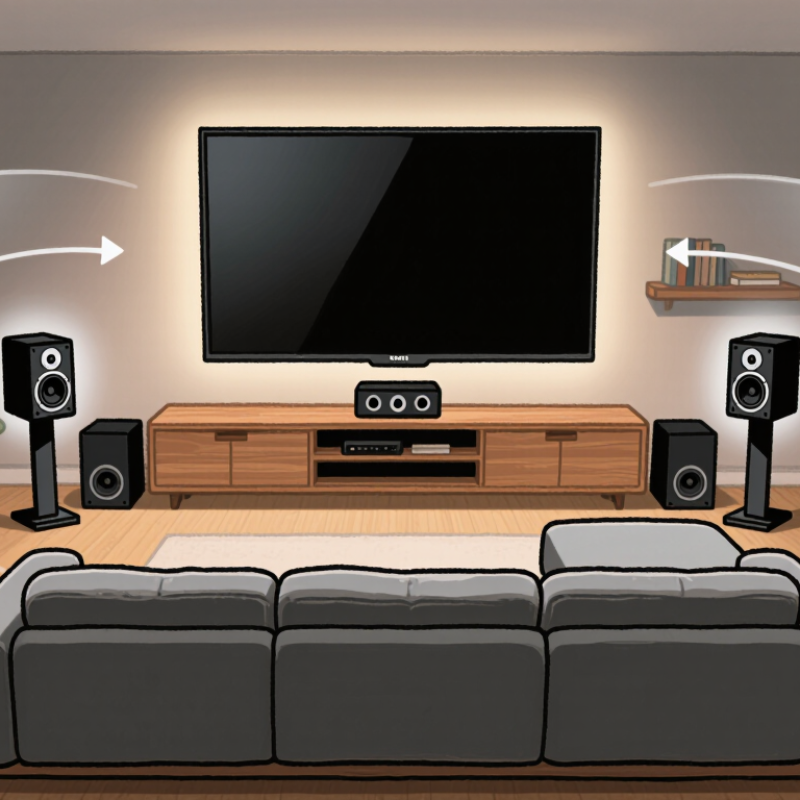
Rear surround speakers extend the soundstage behind the listening position, helping a home audio system present movement across the room rather than only from the front. In a film scene, footsteps may begin near the screen and continue behind the sofa. Properly placed rear channels make that shift easier to follow. They also add quiet environmental details, such as rain or distant crowd noise, without making every sound louder.
Their role depends on the whole system. In a 5.1 setup, surround speakers usually sit to the sides or slightly behind the main seats; a 7.1 system adds dedicated rear channels. Follow your receiver’s layout guidance, and avoid placing speakers directly against a listener’s head. That matters. Room shape, furniture, and reflective walls can change what you hear. Use the system’s calibration tool as a starting point, then check familiar scenes at a comfortable volume. If effects seem distracting or voices lose focus, adjust placement or channel levels. Small changes can help, though calibration is not magic. A few rooms remain awkward, and careful setup may take more than one try.
Rear surround speakers expand sound beyond the television, helping a room feel less like a box with sound coming from one wall. A soft footstep behind the listener or rain moving across the back of a scene gives the sound field depth. Small cues matter. The ITU-R BS.775-3 recommendation places the surround pair in a 5.1 system at roughly 100 to 120 degrees from the forward-facing center line. This geometry helps sounds arrive from the sides and rear, rather than clustering near the screen.
In larger layouts, dedicated rear channels can make movement across the room feel more continuous. A helicopter passing overhead is one example: its sound can travel from the front, around the sides, and behind the seating area. ITU-R BS.2051 describes multichannel arrangements with additional surround positions for more enveloping reproduction. But extra speakers alone do not guarantee spaciousness. Poor placement, mismatched levels, or a reflective side wall can blur direction. And honestly, placement is easy to get wrong. A practical check is to play a quiet, steady ambience and listen for gaps behind the seat. The effect should feel broad, not simply louder.
Typical 7.1 speaker azimuths, measured in degrees from the front-center listening direction
The values show the midpoint of common placement ranges: front left/right 22–30°, side surrounds 90–110°, and rear surrounds 135–150°. Rear speakers add coverage behind the listener, helping sounds move more smoothly around the room and creating a more spacious sound field.
Rear surround speakers and side surround speakers create different parts of the sound field. Side surrounds sit beside or slightly behind the listening position. They carry sounds that seem to pass across the room, such as footsteps moving from one side to another. Rear surrounds sit behind the listener. In a 7.1-channel setup, they help place effects farther behind you, making a passing aircraft or distant crowd feel more continuous. In a 5.1 setup, surround speakers are often positioned to the sides or just behind the seating area, so the distinction depends partly on the system layout.
Tips: Check your receiver’s speaker layout before moving speakers. Aim side surrounds toward the listening area, and place rear surrounds behind it when your system supports them. Keep left and right speakers at similar heights. Small room differences matter.
Placement is not magic. A sofa against the back wall may leave little space for rear speakers, and forcing them into awkward corners can make effects sound lopsided. Try a short scene with clear movement, then adjust speaker angles or levels in small steps. Listen from the main seat, not while standing beside a speaker. Even careful setup can feel imperfect; room shape and reflective surfaces change what you hear.
Rear surround speakers do more than make effects louder. Their position determines whether a scene feels broad, precise, or oddly disconnected. In a typical living room, place them slightly behind the listening position, on either side, near ear height or a little above. Exact placement depends on room shape and seating; a sofa against a wall changes the options. Keep left and right distances similar when possible. Small differences matter.
Aim speakers toward the listening area, but avoid pointing them directly at one seat if several people watch. A modest upward angle can soften a sound that feels too localized. Leave space from corners, where bass may become boomy. During setup, play a familiar scene with footsteps moving across the rear field. Listen for a smooth transition, not just dramatic volume. If a sound jumps from front to back, adjust the angle or distance settings, then test again. The process is less exact than diagrams suggest. Rugs, curtains, and bare walls change reflections, and my first placement may still be wrong. Trust careful listening, then make one change at a time.
Rear surround speakers matter most when a soundtrack places clear sounds behind the listener, not merely around the room. In a 7.1 setup, side surrounds handle sounds beside you, while rear speakers help carry movement across the back of the listening area. A helicopter crossing overhead may feel less like a sound jumping from left to right and more like a continuous sweep. Quiet details count, too: rain behind a scene or a door closing out of view can make the room feel more connected to the action. Subtle, but noticeable.
They make the greatest difference in a room with enough space behind the seats for sound to arrive from distinct directions. A listener seated close to the back wall may hear the rear channels as a narrow, distracting cluster instead. That matters. Multiple seating rows can benefit, especially when the system is calibrated for the main listening area and speaker levels are balanced. For films with busy surround mixes, the improvement is often easier to notice than during dialogue-heavy scenes. Games can benefit when directional cues help place activity behind the player, though they should not replace careful screen and speaker positioning. I would not expect rear speakers to fix weak bass, poor dialogue clarity, or an awkward room layout. Sometimes the honest answer is that better placement matters more.
They place sounds behind and beside the listener, beyond the television. Quiet footsteps or moving rain can add depth.
Place them slightly behind the listening position, one on each side. Ear height or a little above often works.
In a typical 5.1 setup, aim for roughly 100 to 120 degrees from the forward-facing center line. Room shape may require adjustments.
Keep their distances similar when possible. Small differences can affect how evenly sounds move behind the seating area.
Aim them toward the listening area, but not necessarily at one seat. A slight upward angle may help soften overly focused sound.
Play a quiet, steady ambience and listen for gaps behind your seat. It should feel broad, not merely louder.
Adjust the speaker angle or distance settings, then test again. Change one thing at a time.
Yes. Rugs, curtains, and bare walls change reflections. Corners can make bass sound boomy, and my first placement may still be wrong.
Rear Surround Speakers play an important role in a home audio system by adding sounds that seem to come from behind the listener. Along with front and side speakers, they help create a more spacious, immersive sound field, making movie scenes and game environments feel less confined to the screen. Rear speakers complement side surround speakers: side speakers provide sounds from beside the listening area, while rear speakers help fill in the space behind it.
Their impact depends on placement. Positioning them behind the main listening area and aiming them appropriately can make surround effects feel more balanced and convincing. The exact setup may vary with the room and seating arrangement, but careful placement helps sounds blend naturally rather than stand out as isolated effects. Rear speakers make the greatest difference in systems designed for multichannel audio, especially when content includes distinct sounds moving around the room or activity occurring behind the listener.
