Ruoca Audio Ruoca Audio

China Top Sound System Manufacturers for Global Buyers

Time:2026-10-10 Author:Sienna
0%

China has become a significant sourcing base for professional audio equipment, from compact conference speakers to large-format concert systems. For global buyers, choosing among China Top Sound System Manufacturers requires more than comparing factory prices. Product consistency, engineering support, certifications, and export experience deserve equal attention.

Industry data supports this market’s continued expansion. AVIXA’s 2024 Industry Outlook and Trends Analysis describes professional audiovisual demand as resilient across live events, corporate communication, education, and hospitality. Grand View Research also reports sustained growth in the global loudspeaker market, driven by wireless connectivity, smart devices, and commercial installations. These trends create opportunities for manufacturers offering line arrays, powered speakers, digital mixers, amplifiers, and integrated Sound System solutions.

However, growth does not guarantee quality. A polished showroom may hide uneven component sourcing or limited after-sales support. Buyers should request frequency-response charts, maximum SPL data, distortion measurements, sample testing, and production records. They should also verify applicable safety and electromagnetic-compatibility requirements before placing volume orders. Small details matter. Connector quality matters.

Experienced sourcing teams often assess factory capacity through an on-site audit or documented quality-control process. They check burn-in testing, acoustic calibration, packaging strength, spare-parts availability, and warranty procedures. No supplier is perfect, and even a reliable factory may have weaknesses in software, documentation, or overseas service. That reality deserves honest review. The strongest Chinese manufacturers combine competitive production, measurable performance, clear communication, and practical support after shipment. This guide examines those factors for international distributors, installers, rental companies, and brand owners.
China Top Sound System Manufacturers for Global Buyers

Market Overview of China’s Sound System Manufacturing Industry

China’s sound system manufacturing industry serves concerts, hotels, schools, houses of worship, and commercial venues worldwide. Its strength comes from a dense supply chain for speakers, amplifiers, mixers, wireless components, cabinets, and cables. Manufacturers can source parts quickly and adjust production for different project sizes.

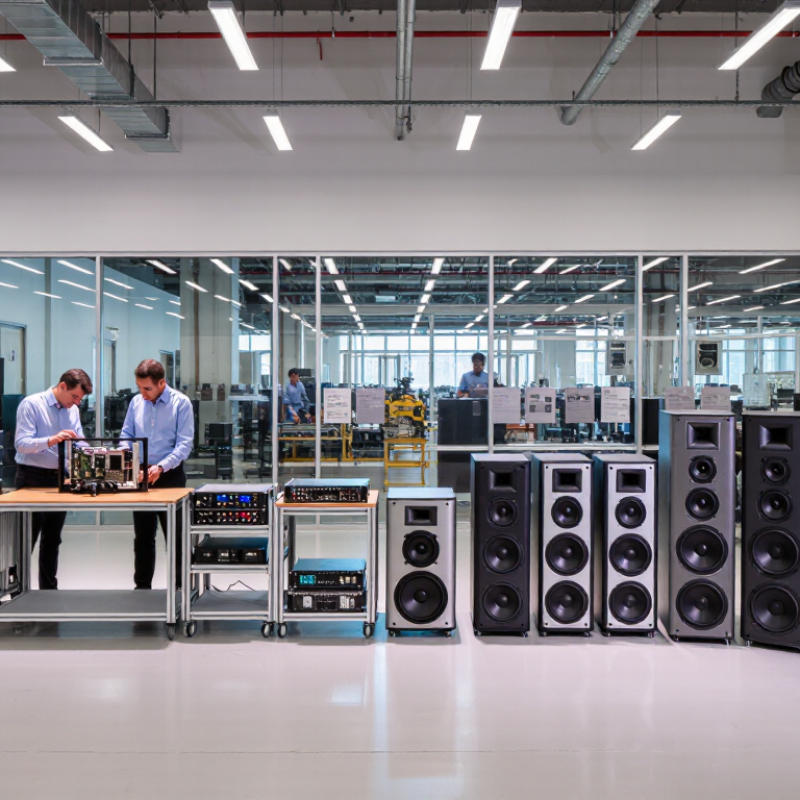
Large factories often combine engineering teams with automated assembly and acoustic testing rooms. Smaller specialists may offer faster customization and more direct communication. Export buyers should examine frequency response data, power ratings, distortion levels, and thermal performance. Factory audits also reveal details that brochures rarely show. Check soldering quality, connector durability, packaging strength, and spare-part availability.

Quality varies.

Reliable suppliers normally provide sample testing, traceable production records, and clear inspection procedures. They should explain how products perform in humid warehouses, outdoor events, or unstable electrical conditions. International compliance documents matter, but documents alone are not enough. An independent inspection can confirm whether production matches the approved sample. Price remains competitive in China, although the cheapest quotation may hide weaker components or limited after-sales support. The market is not perfectly predictable. Freight costs, component shortages, and changing project specifications can affect delivery schedules. Buyers may also underestimate acoustic design, treating equipment selection as a simple product purchase. That mistake can create uneven coverage, feedback, and unnecessary replacement costs.

China Top Sound System Manufacturers for Global Buyers

China’s sound-system manufacturing base is strongly export-oriented. Loudspeakers, headphones, microphones and audio amplifiers represent the main product groups within China’s audio-equipment supply chain, supported by large-scale electronics production, component availability and contract manufacturing capacity.

Data basis: rounded 2023 export-value estimates for China’s principal audio-equipment categories, aligned with UN Comtrade HS 8518 product classifications. Values are shown in USD billions and exclude company or brand-level data.

Key Product Categories Offered by Chinese Audio Manufacturers

China Top Sound System Manufacturers for Global Buyers

Chinese audio manufacturers offer broad product categories for different venues and budgets. Professional loudspeakers include line arrays, point-source cabinets, subwoofers, and stage monitors. These systems support concerts, hotels, houses of worship, and outdoor events. Many factories also produce power amplifiers, digital mixers, wireless microphones, wired microphones, and signal processors. Portable column speakers and battery-powered systems suit mobile presenters and small venues. Installation products often include ceiling speakers, wall-mounted speakers, paging systems, and conference audio equipment.

From practical sourcing experience, product matching matters more than a low unit price. A powerful amplifier may damage speakers when impedance settings are wrong. A compact mixer may lack enough inputs for a growing event team. Buyers should request frequency-response charts, maximum SPL data, distortion figures, connector details, and real testing videos. Factory audits can reveal assembly quality, acoustic testing rooms, packaging standards, and spare-parts support. Certifications should match the destination market. Yet specifications can look impressive on paper. Field performance may still vary.

Tips: Compare complete systems, not isolated products. Ask for a sample before bulk purchasing. Check warranty terms, replacement parts, firmware support, and production lead times. Test speech clarity at the rear of the venue. Also inspect fan noise and cabinet vibration. These small details are easy to overlook. Some suppliers need clearer documentation, so buyers should confirm every technical point in writing.

How to Evaluate China’s Sound System Suppliers

China Top Sound System Manufacturers for Global Buyers

How to Evaluate China’s Sound System Suppliers

China offers broad sound-system manufacturing capacity, but supplier selection requires evidence beyond attractive pricing. AVIXA’s 2024 Industry Outlook estimates the global professional AV market at about US$332 billion in 2024. That scale increases choice, but also increases quality variation. Request a factory profile, production photos, test records, and recent export references. Confirm whether the supplier owns its production lines or mainly outsources assembly. That distinction affects consistency.

Evaluate samples under realistic conditions. Measure frequency response, maximum sound pressure level, distortion, noise, and heat performance. Ask for test methods, not only impressive figures. A reliable supplier should provide traceable inspection records and explain failed tests. Check component substitution rules, firmware control, packaging protection, and spare-parts availability. ISO 9001 certification can indicate process discipline, but it does not guarantee acoustic performance. A spreadsheet can still lie by omission.

Tips: Use an independent pre-shipment inspection. Test at least three samples from different batches. Compare warranty terms, response time, and replacement procedures in writing. Also review applicable safety and electromagnetic-compatibility requirements for the destination market. IEC standards may guide testing, while local authorities control final compliance. Do not judge a supplier from one successful prototype. My own practical caution is simple: factory visits reveal useful details, yet they can also create false confidence. Production records and repeat samples matter more than polished showrooms.

China Top Sound System Manufacturers for Global Buyers - How to Evaluate China’s Sound System Suppliers

Evaluation Dimension Suggested Weight What to Check Reliable Evidence Buyer Benchmark
Product Compliance 15% Confirm that the proposed sound system matches the electrical, safety, and radio requirements of the destination market. Valid test reports, declarations of conformity, technical files, and product labels applicable to the target country. Documents must identify the exact model, revision, rated voltage, and applicable standards.
Audio Performance 15% Evaluate frequency response, maximum sound pressure level, total harmonic distortion, sensitivity, coverage, and system stability. Independent or calibrated laboratory measurements, complete datasheets, measurement conditions, and listening-test samples. Compare suppliers using the same test method and the same operating conditions rather than headline specifications alone.
Manufacturing Quality 15% Review incoming-material inspection, production controls, final testing, traceability, and corrective-action procedures. Quality manual, inspection records, process flow, sample production video, and a permitted factory audit. A documented quality system with measurable acceptance criteria for drivers, amplifiers, cabinets, wiring, and packaging.
Testing Capability 10% Determine whether the facility can test acoustics, electrical safety, endurance, vibration, temperature, and wireless functions where relevant. Equipment list, calibration certificates, test procedures, retained samples, and sample test records. Test equipment should be calibrated and linked to defined acceptance limits before mass production.
Customization and Engineering 10% Assess enclosure design, acoustic tuning, firmware, connectors, control panels, packaging, and private-label support. Engineering change process, drawings, sample approval procedure, prototype timetable, and ownership terms for design files. All custom specifications should be frozen in an approved specification sheet before production.
Production Capacity and Lead Time 10% Check monthly capacity, component availability, peak-season planning, sample lead time, and mass-production lead time. Capacity plan, production schedule, supplier lead-time records, and recent on-time delivery data. The supplier should provide a written production schedule with inspection and shipment milestones.
Commercial Terms and Total Cost 10% Compare unit price, tooling, sampling, packaging, payment terms, spare parts, warranty exposure, and shipping assumptions. Itemized quotation, Incoterms® rule, warranty terms, tooling agreement, and landed-cost calculation. Select on total landed cost and risk-adjusted value, not on the lowest unit price.
Export and Logistics Readiness 5% Review export documentation, carton design, palletization, moisture protection, spare-parts handling, and freight coordination. Commercial invoice, packing list, carton specifications, shipping records, and packaging test results. Packaging should protect heavy or fragile components during international handling and meet the buyer’s transport requirements.
After-Sales Support 5% Assess response time, troubleshooting, replacement parts, repair instructions, firmware support, and warranty handling. Written warranty policy, spare-parts list, service-level commitments, fault-analysis reports, and support contacts. Support procedures should define response times, replacement responsibilities, and the treatment of recurring defects.
Total Evaluation Score 100% Use a consistent 1–5 score for each dimension, multiply by the suggested weight, and verify all critical claims before placing an order.

Note: Certification and compliance requirements vary by destination market, product type, voltage, wireless function, and intended use. Buyers should verify current requirements with the relevant authority or qualified testing body.

Manufacturing Standards, Quality Control, and Certifications

China Top Sound System Manufacturers for Global Buyers

Reliable sound system manufacturing starts with documented standards, not attractive specifications. A capable factory controls drawings, component revisions, and approved suppliers. Incoming inspectors check drivers, amplifiers, wiring, and cabinet materials against defined samples. Measurements should include frequency response, sensitivity, impedance, distortion, and maximum sound pressure. These results need calibrated instruments and dated records.
Production teams should use assembly checklists, torque limits, polarity tests, and controlled firmware versions. Random units can receive burn-in testing under monitored temperature conditions.
Quality control continues beyond the laboratory. Packaging checks matter too. A loose connector or weak corner protector can damage performance during a long shipment. Serial numbers should connect each unit to materials, operators, test results, and final approval.

Certifications require careful verification. Depending on the destination, buyers may request CE, RoHS, FCC, UKCA, or other applicable compliance evidence. Certificates should match the exact model, electrical design, and current production version.

An experienced manufacturer can provide test reports, declarations, and audit records without avoiding difficult questions. No factory is perfect. Calibration can drift, and an occasional batch may fail.

What matters is transparent containment, root-cause analysis, and documented corrective action. Ask how failures are handled, not only how products pass.

Export Services, Customization, and Global Buyer Support

China Top Sound System Manufacturers for Global Buyers

Export Services, Customization, and Global Buyer Support

Global buyers now expect more than competitive pricing from Chinese sound system manufacturers. AVIXA’s 2024 Industry Outlook estimated the professional audiovisual market at about $325 billion in 2024. This growth increases demand for reliable export service, not just loudspeakers and amplifiers.

Experienced manufacturers should provide pre-shipment testing, packing photographs, commercial invoices, and accurate certificates of origin. They should also explain voltage, frequency, connector, and safety requirements before production. Customization may include cabinet dimensions, grille colors, control panels, logos, and preset tuning. However, customization can create delays when specifications remain unclear. A signed technical drawing helps. So does a sample unit.

Global support matters after delivery. Buyers need installation guides, remote troubleshooting, replacement-part planning, and clear warranty terms. The International Trade Centre highlights the importance of accurate trade documentation for smoother cross-border transactions. A capable supplier should answer within a defined time, even when the problem is inconvenient. No supplier gets every shipment perfect. Transparency reveals professionalism.

Tips: Request a sample, inspection report, wiring diagram, and spare-parts list before placing a large order. Compare response quality, not only price. Ask whether support continues after installation.

FAQS

What types of projects can China’s sound system factories support?

They serve concerts, hotels, schools, worship spaces, homes, and commercial venues. Many factories adjust production for small rooms or large events. Fit matters.

How should buyers compare potential suppliers?

Request factory profiles, production photos, test records, and recent export references. Confirm whether the factory owns its production lines or outsources assembly. Outsourcing is not automatically poor, but consistency may become harder to control.

What should buyers test in sound system samples?

Measure frequency response, sound pressure, distortion, noise, impedance, and heat performance. Use realistic conditions, such as high volume and long operating periods. Test at least three samples from different batches.

Why are factory audits useful?

Audits can reveal soldering quality, connector strength, assembly methods, and packaging practices. They may also show spare-parts storage and production records. A polished showroom proves little.

Which quality-control records should a reliable supplier provide?

Look for dated inspection results, serial-number tracking, component records, and final approval details. Useful controls include polarity tests, torque checks, firmware control, and burn-in testing. Records can still omit problems. Ask about failed units.

Do compliance documents guarantee product quality?

No. Documents should match the exact model, electrical design, and current production version. Independent inspection can confirm whether production matches the approved sample. Compliance and acoustic performance are different questions.

How can buyers prepare for outdoor or difficult operating conditions?

Ask how products perform in humid warehouses, outdoor events, and unstable electrical conditions. Check thermal performance, cabinet protection, connector durability, and packaging strength. Real conditions are harsher.

What hidden costs can affect the purchase?

Freight changes, component shortages, replacement parts, and delayed specifications can increase total costs. A low quotation may include weaker components or limited after-sales support. Cheap is not always economical.

Why is acoustic design important when selecting equipment?

Equipment alone cannot guarantee even coverage or clear sound. Poor selection may create feedback, uneven volume, and unnecessary replacements. I might still underestimate room acoustics. A site review helps.

Conclusion

China has become a major manufacturing base for sound equipment, offering a broad range of products for commercial, residential, professional, and public-use applications. This article explores the development of China’s Sound System manufacturing industry and introduces key product categories, including portable speakers, line-array systems, conference audio equipment, amplifiers, mixers, microphones, and integrated audio solutions. It also explains how global buyers can compare suppliers by assessing production capacity, technical expertise, product consistency, communication efficiency, and after-sales support.

In addition, the article reviews manufacturing standards, quality-control procedures, testing practices, and commonly requested certifications that help ensure reliable international trade. It highlights the export services available from Chinese manufacturers, such as packaging, logistics coordination, documentation, OEM and ODM customization, and technical assistance. By understanding these factors, buyers can identify suitable suppliers, reduce procurement risks, and build long-term cooperation based on product quality, compliance, delivery performance, and responsive customer service.

Sienna

Sienna

Sienna is a skilled marketing professional with a deep expertise in our company’s core products and services. With a passion for innovation and detail, she plays a pivotal role in crafting insightful blog posts that not only highlight the unique features of our offerings but also provide valuable......