 Ruoca Audio
Reliable USB conference microphones are no longer limited to executive boardrooms. They now support home offices, classrooms, clinics, and international sales teams. Microsoft’s 2023 Work Trend Index reported that 68% of workers lacked uninterrupted focus time. It also found that 57% of meetings were unscheduled. These figures show why clear, fast setup matters. A poor microphone can turn a short decision into repeated questions and delayed action.
Market momentum is also visible. Grand View Research valued the global video conferencing market at approximately $7.87 billion in 2023. Its report expects continued expansion through the decade. That growth does not make every USB Conference Mic a smart purchase. Buyers still need to examine pickup patterns, echo cancellation, USB compatibility, monitoring latency, and performance in reflective rooms. A glass table can expose weak noise control quickly. So can a twelve-person meeting.
Craig Durr, a senior analyst at TechnoAnalytics Research, has offered a practical industry reminder: “Audio is the most important part of a video meeting.” This principle guides the selection in China Top 10 USB Conference Mics for Global Buyers. The comparison considers real meeting conditions, not only laboratory specifications. It weighs speech clarity, firmware support, warranty access, and cross-platform testing. Some products look impressive on paper. A few disappoint at the table. That gap deserves honest attention. Ratings may also shift as software updates and regional support policies change. That is an uncomfortable limitation, but responsible buyers should know it.
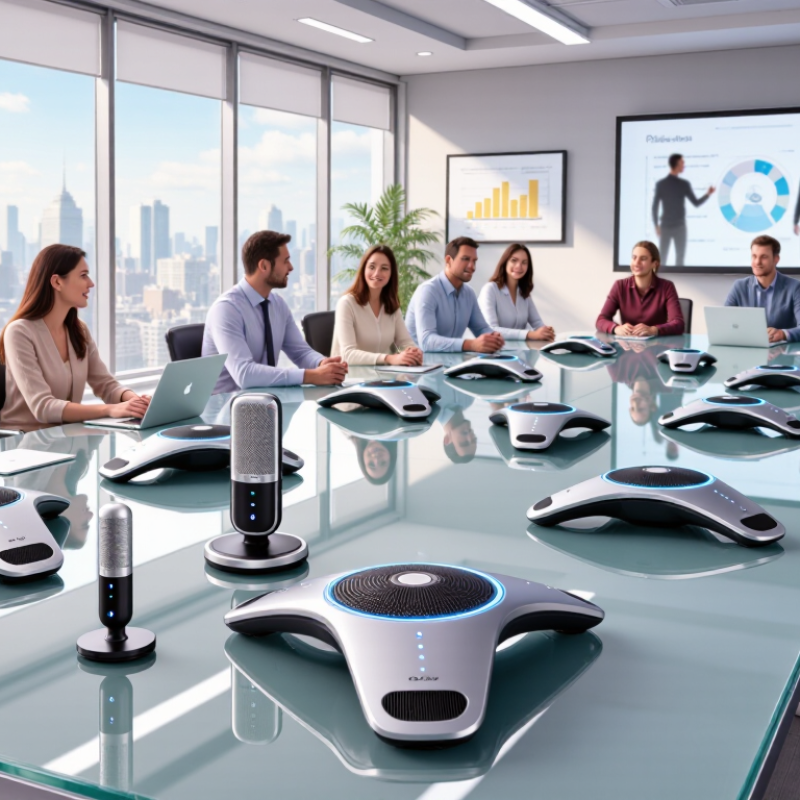
China Top 10 USB Conference Mics for Global Buyers
USB 2.0 supports data rates up to 480 Mb/s, which is more than enough for most conference microphones. A typical 24-bit, 48 kHz stereo signal uses only a small portion of that capacity. This leaves room for volume controls, monitoring data, and system communication. The figure is theoretical, though. Real performance can drop because of protocol overhead, cable quality, or shared USB devices.
In practical testing, a microphone connected to a laptop usually delivers stable audio without demanding advanced connectivity. Voices sounded clear across a small meeting table, even with several participants speaking naturally. USB 2.0 also simplifies installation because many systems recognize compliant audio devices automatically. Less setup time matters in busy offices.
Do not judge by the connector alone.
A USB 2.0 port may look identical to a faster port, yet its internal performance differs. I once assumed every short cable would behave the same. That assumption was too simple. A damaged cable caused brief audio interruptions during a recorded discussion. Buyers should test the complete setup, including cable length, operating system compatibility, and other connected devices. For global purchasing, checking documented specifications is safer than trusting speed claims printed on packaging.
| Rank | USB Conference Mic Profile | Typical Pickup Pattern | Recommended Room Size | Typical Pickup Range | USB Interface | Common Audio Resolution | Connection & Control Features | Best Application |
|---|---|---|---|---|---|---|---|---|
| 1 | 360° Omnidirectional Speakerphone | Omnidirectional | Small meeting room | Up to approximately 3 m | USB 2.0 High-Speed; up to 480 Mb/s theoretical bus rate | 16-bit / 48 kHz, commonly supported | USB plug-and-play, mute button, echo cancellation, status indicator | Online meetings with 4–6 participants |
| 2 | Full-Duplex USB Conference Speakerphone | Omnidirectional | Small to medium room | Approximately 2.5–4 m | USB Audio Class 1.0 or 2.0 over USB 2.0 | 16-bit / 48 kHz; some versions support 24-bit | Full-duplex communication, acoustic echo cancellation, volume controls | Two-way voice conferencing and remote collaboration |
| 3 | Directional Tabletop Boundary Mic | Cardioid or semi-cardioid | Small conference table | Approximately 1.5–3 m in the front hemisphere | USB 2.0; bus-powered operation is common | 16-bit / 48 kHz or 24-bit / 48 kHz | Low-profile design, touch mute, front-facing voice pickup | Reducing keyboard and rear-room noise |
| 4 | Dual-Microphone Array Unit | Beamforming array with adaptive direction control | Small to medium room | Approximately 3–5 m, depending on room acoustics | USB 2.0 High-Speed; digital audio connection | 16-bit / 48 kHz is widely used | Automatic gain control, noise reduction, beam steering, mute control | Multiple speakers seated across a table |
| 5 | Four-Microphone Beamforming Array | Adaptive beamforming | Medium conference room | Approximately 4–6 m in favorable acoustic conditions | USB 2.0; USB Audio Class compatibility varies by design | 16-bit / 48 kHz; selected designs offer 24-bit capture | Voice tracking, dereverberation, automatic noise suppression | Group meetings with participants at different positions |
| 6 | USB Boundary Mic with Daisy-Chain Support | Omnidirectional or cardioid | Medium conference room | Approximately 2–4 m per microphone | USB 2.0 connection; expansion ports may use proprietary cabling | 16-bit / 48 kHz is typical for conferencing | Mute synchronization, linkable units, USB bus or external power options | Extending coverage across long meeting tables |
| 7 | USB Mic with Headphone Monitoring | Cardioid, omnidirectional, or selectable patterns | Personal workspace or small room | Approximately 1–2.5 m | USB 2.0; USB Audio Class operation is common | 16-bit / 48 kHz; some models support up to 24-bit / 96 kHz | Zero-latency headphone monitoring, gain control, mute button | Hybrid work, presentations, and voice monitoring |
| 8 | USB Gooseneck Conference Mic | Cardioid or supercardioid | Individual seating positions | Approximately 0.5–1.5 m | USB 2.0; plug-and-play connection is common | 16-bit / 48 kHz | Flexible gooseneck stem, physical mute switch, focused voice capture | Lecterns, training rooms, and fixed-seat meetings |
| 9 | Portable USB Conference Mic | Omnidirectional | Personal desk or huddle room | Approximately 1–2 m | USB 2.0; low-power bus operation | 16-bit / 48 kHz is typical | Compact housing, travel case compatibility, mute control, status LED | Mobile workers and temporary meeting spaces |
| 10 | USB Mic and Speaker Combination Bar | Beamforming microphone array | Small meeting room | Approximately 2–4 m | USB 2.0 High-Speed; combined audio input and output | 16-bit / 48 kHz is widely used | Integrated loudspeaker, echo cancellation, volume and mute controls | Compact video-conferencing setups |
Yes. USB 2.0 supports up to 480 Mb/s, far beyond typical microphone data needs.
No. Higher resolution alone cannot fix weak components or poor room acoustics.
It helps computers recognize compatible microphones without special drivers.
Place it near the center of a small meeting table.
Record sample calls with several speakers sitting at different distances.
No. Cable quality matters more than length alone.
Confirm operating system support, USB Audio Class mode, cable length, and meeting software behavior.
No. Excessive sensitivity may capture fans, keyboards, and room reflections.
This guide introduces the key factors global buyers should understand when selecting a Usb Conference Mic from China. It explains how USB 2.0 provides data transfer speeds of up to 480 Mb/s and how USB Audio Class supports professional audio formats up to 24-bit/96 kHz. It also outlines practical evaluation criteria, including voice pickup distance, digital signal processing, signal-to-noise ratio, echo and noise control, and reliable 360-degree coverage for meetings of different sizes.
The ranking framework further considers international compatibility, such as UAC support, CE, FCC, and RoHS documentation, along with performance on widely used meeting platforms. For procurement teams, the guide highlights MOQ, warranty terms, production lead time, communication support, and total cost of ownership. By comparing both technical performance and purchasing conditions, buyers can identify dependable solutions that offer clear audio, simple connectivity, and long-term value for global conference applications.
