 Ruoca Audio
Ruoca Audio
Ruoca Audio
Choosing the China Best Bluetooth Lavalier Mic for wholesale buyers requires more than comparing factory prices. Product reliability, audio clarity, battery life, and supplier communication all affect your final customer experience. A microphone may look excellent in product photos, yet perform poorly in a busy showroom or outdoor interview.
This guide focuses on practical purchasing details. We examine microphone sensitivity, Bluetooth stability, charging time, operating distance, and compatibility with common smartphones, cameras, and computers. We also consider compact transmitters, protective cases, wind protection, and the real convenience of USB-C charging. Small details matter. A loose clip can damage usability.
Experienced buyers should request samples before placing larger orders. Test voices from different distances. Check background noise in offices, shops, and streets. Review battery performance after repeated charging cycles. Ask suppliers for clear specifications, inspection records, packaging details, and market-specific compliance documents. Factory visits, video inspections, and third-party quality checks can reduce uncertainty.
Price still matters, but the cheapest option may create higher return costs. No supplier is perfect. Even a promising sample may not represent every production batch. That limitation deserves attention. A reliable sourcing decision should balance unit cost, minimum order quantity, lead time, warranty support, and communication speed. This article compares practical supplier qualities and product features, helping wholesale buyers make a more informed and dependable choice.
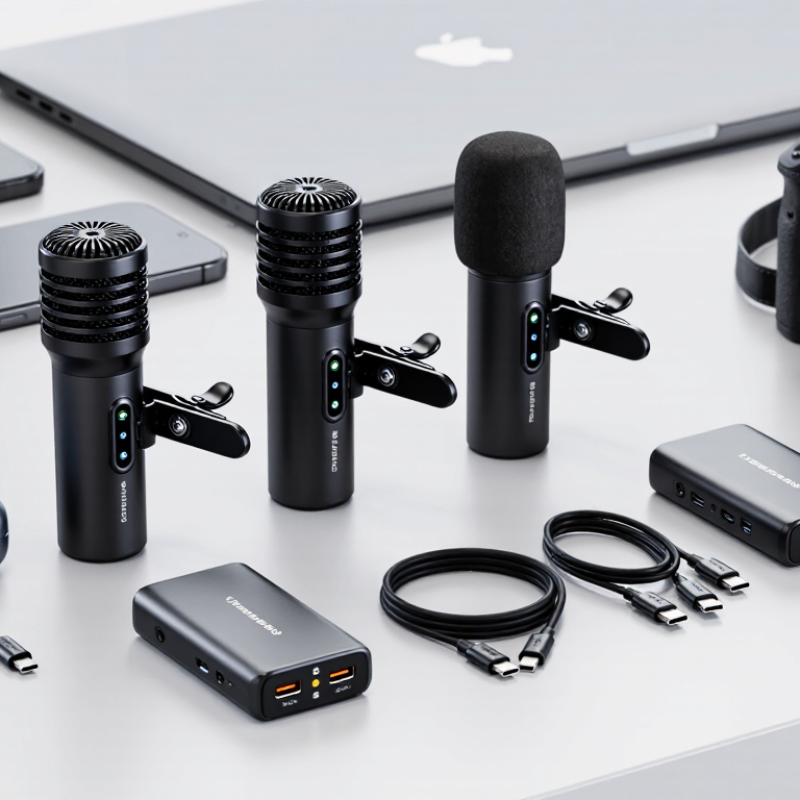
China Best Bluetooth Lavalier Mic for Wholesale Buyers?
Bluetooth SIG projects 7.6 billion Bluetooth devices shipped in 2027, according to its Market Update forecast. This figure signals expanding demand for compact wireless audio. It does not guarantee equal demand for every microphone category. A shipment forecast is not a purchasing forecast.
For wholesale buyers, the practical question is performance at scale. Test voice clarity across a busy showroom, a tiled room, and an outdoor loading area. Check pairing time, connection stability, battery duration, charging speed, and microphone weight. A lightweight clip should stay secure on a moving presenter. Buyers should also review measured latency and wireless operating details. Product claims can sound impressive. Test them independently.
Tips: Request sample units before placing bulk orders. Record speech from 30 centimeters away, then repeat from two meters. Compare background noise, plosive sounds, and voice volume. Ask suppliers for battery-cycle data and quality-control records. Bluetooth SIG’s forecast supports long-term category interest, while market research reports from Grand View Research also describe continued growth in wireless audio equipment. However, those reports often combine several product types. That makes direct lavalier estimates less certain. Do not confuse broad market growth with guaranteed wholesale turnover. Steady quality may matter more than the lowest quoted price.
| Data Dimension | Market Baseline | Wholesale Buyer Relevance | Recommended Evaluation Point |
|---|---|---|---|
| Global Bluetooth device shipments | Projected at approximately 7.6 billion units in 2027, according to the Bluetooth SIG market forecast. | Indicates a large and expanding ecosystem for wireless accessories, including microphones. | Prioritize products compatible with mainstream smartphones, tablets, computers, and cameras. |
| Bluetooth technology generation | Bluetooth 5.x is the current mainstream generation used across many modern consumer devices. | Newer generations can support improved range, efficiency, and connection reliability, depending on the complete product design. | Request the exact Bluetooth version, supported profiles, and compatibility test results. |
| Bluetooth Classic audio support | A2DP is widely used for stereo audio streaming, while HFP is commonly used for hands-free communication. | Profile support affects compatibility with phones, laptops, vehicle systems, and other audio hosts. | Confirm A2DP and HFP support when the microphone is intended for broad device compatibility. |
| Bluetooth Low Energy Audio | LE Audio uses the LC3 codec and is designed to improve efficiency and audio flexibility compared with legacy Bluetooth audio architectures. | It may support lower power consumption and newer broadcast or multi-stream use cases when both devices are compatible. | Treat LE Audio as a future-oriented feature and verify end-to-end transmitter and receiver compatibility. |
| Operating range | Bluetooth range varies with transmit power, antenna design, receiver sensitivity, radio interference, and physical obstacles. | Marketing range alone does not guarantee stable speech transmission in offices, classrooms, or event venues. | Require an open-area range test and an indoor interference test using the intended receiver. |
| Microphone pickup design | Omnidirectional lavalier capsules are common because they capture speech without requiring precise alignment. | Pickup pattern influences voice consistency, background-noise rejection, and suitability for presenters. | Request polar-pattern charts, speech samples, sensitivity specifications, and noise-performance results. |
| Battery operating time | Actual runtime depends on microphone power consumption, transmission settings, battery capacity, and usage conditions. | Longer tested runtime reduces interruptions during classes, interviews, livestreams, and events. | Compare runtime using a consistent test method and record charging time, battery type, and charging interface. |
| Audio delay | Wireless audio latency depends on the codec, radio conditions, device processing, and recording or video software. | Lower and more consistent latency is important for video recording, online teaching, and live presentations. | Test lip-sync performance with the target phone, camera, computer, and application rather than relying only on a specification sheet. |
| Charging and connectivity | USB Type-C has become a common charging interface for current portable electronics, but connector compatibility still varies by product. | A standardized charging workflow simplifies inventory, customer support, and replacement purchasing. | Confirm charging-port type, cable contents, charging protection, and whether the receiver requires an adapter. |
| Compliance and documentation | Wireless products may require market-specific radio, safety, electromagnetic-compatibility, and environmental documentation. | Complete documentation helps reduce customs delays, marketplace listing issues, and after-sales risk. | Request applicable test reports, declarations, labeling files, user manuals, and shipment documentation before placing a bulk order. |
Note: Bluetooth SIG shipment figures are industry projections. Product performance specifications should be verified through samples and controlled testing before wholesale purchase.
Look for repeatable field performance, not attractive specifications alone. Test several units under the same speaking distance and room conditions. Quiet pauses should remain clean. Fan noise should not dominate recordings.
A practical target is 65 dB(A) or higher. Measure speech and silence from a fixed distance. Record the room temperature, microphone position, and background noise. Small setup changes can affect results.
No. Coverage alone does not prove natural speech reproduction. Listen carefully between 100 Hz and 8 kHz. Voices should retain body, clarity, and stable volume. Request a measured response chart with tolerance information.
Test the microphone during live teaching, interviews, or phone video. A complete wireless delay below 30 milliseconds is generally preferable. Use a hand clap beside a direct reference recording. Watch the mouth and sound together. Test it directly.
Measure runtime at normal volume, rather than standby mode. Six to eight hours may be realistic for some designs. Cold rooms, high gain, and repeated pairing can reduce runtime. Test multiple units over several days. One sample is not evidence.
Request separate minimum order quantities for standard and customized units. Ask for written prices at 100, 500, and 1,000 pieces. The schedule should cover sampling, tooling, production, and inspection. A quoted 20–35 days means little without stage-by-stage dates.
Records should show the model, batch, test date, and inspector. Review pairing stability, microphone sensitivity, battery capacity, charging safety, range, and drop resistance. Serial-linked records are stronger than attractive photographs. I once trusted a polished file too quickly. That judgment needed correction.
Match every document to the exact model and radio configuration. Check the circuit board, battery, charger, firmware, and enclosure. Request conformity declarations, radio test reports, and material-safety evidence. Product changes can invalidate older documents. Verify again after revisions.
For wholesale buyers, choosing the best Bluetooth Lavalier Mic requires more than comparing advertised prices. With Bluetooth SIG projecting 7.6 billion Bluetooth devices shipped in 2027, buyers should focus on products using dependable Bluetooth 5.2, LE Audio, and LC3 technologies for efficient, clear voice capture. Key performance checks include signal-to-noise ratio, a balanced 20 Hz–20 kHz frequency response, stable low latency, connection reliability, and sufficient battery runtime for daily use.
Supplier evaluation is equally important. Compare MOQ requirements, OEM lead times, production capacity, quality-control procedures, and documented CE, FCC, and RoHS evidence. Request samples to test sound quality, range, pairing stability, charging performance, and real-world durability before placing a bulk order. A strong wholesale choice should combine competitive unit cost, responsive warranty support, consistent quality, and predictable landed costs. By measuring sample results against total ownership value rather than price alone, buyers can select a Bluetooth Lavalier Mic that supports reliable resale and long-term customer satisfaction.
